
To study in Slovakia, first choose a specific programme, then read that university or faculty’s admission conditions for the current academic year. Check the deadline, teaching language, tuition, entrance exam and document-recognition rules before submitting anything. A scholarship normally requires a separate application and does not replace university admission.
Current scholarship update (checked 7 September 2026): applications for Slovakia’s 2026/27 scholarship scheme for talented international students are open until 8 September 2026 at 23:59 CEST. The live scheme page is the controlling source; later readers should check it for the next cycle rather than reuse this date.
Start with the programme, not a general university application
Admission conditions in Slovakia are set at university, faculty or programme level. Two programmes at the same university can have different deadlines, fees, language requirements and entrance exams. Use the official PortalVS directory to compare recognised institutions and study programmes, then open the selected faculty’s current admissions notice.
Before applying, record these details for every programme on your shortlist:
- degree level and full-time or part-time format;
- language of instruction and accepted proof of proficiency;
- tuition and application fee, including payment instructions;
- application deadline and whether an additional round is possible;
- entrance examination, interview, portfolio or subject prerequisites;
- documents required at application and at enrolment;
- the recognition route for your previous foreign education.
PortalVS publishes an official application-deadline directory, but the faculty’s admissions notice should still be your final check. There is no single nationwide deadline for all Slovak universities. If the portal and faculty page differ, contact the faculty’s admissions office before paying or submitting.
A realistic university application timeline
| When to act | What to do |
|---|---|
| 9–12 months before study | Shortlist programmes; compare language, tuition, admission tests and recognition requirements. |
| 6–9 months before study | Read the current admissions notice, confirm the exact deadline and begin collecting diplomas, transcripts and language evidence. |
| Before the programme deadline | Submit through the system named by the university, pay the correct application fee and upload every required attachment. |
| After submission | Monitor messages, provide missing documents and attend any examination, interview or portfolio review. |
| After admission | Meet enrolment conditions and arrange recognition, residence, accommodation and insurance where applicable. |
This is a planning framework, not a set of legal deadlines. Applicants waiting for final school results should ask whether provisional documents are accepted and when originals must arrive.
Documents international applicants commonly need
The exact list comes from the programme’s current admission conditions. A typical application may request:
- a completed electronic or paper application;
- passport or identity-document details;
- a secondary-school leaving certificate for bachelor’s study, or a bachelor’s diploma for master’s study;
- transcripts or a list of completed subjects and grades;
- official translations where required;
- proof of language ability;
- a CV, motivation letter, portfolio or medical confirmation if the programme asks for one;
- proof that the application fee was paid with the correct reference.
Do not assume that every foreign document always needs the same translation, apostille or legalisation. The answer depends on the issuing country, document and recognition route. Ask the admissions office what it needs, then confirm the recognition procedure through the Ministry’s official portal.
If you plan to study in Slovak, language requirements also vary. Some programmes require a certificate or their own assessment. Our guide to free Slovak courses and learning resources can help you plan preparation, but it does not replace the faculty’s accepted-language-evidence list.
Scholarships: apply separately and check the exact purpose
“Scholarship in Slovakia” can describe several different types of funding. Check whether a scheme supports a complete degree, a temporary mobility stay, a particular nationality or study field, or only students who are already enrolled.
2026/27 scholarship for talented international students
The current official talent-scholarship page covers selected full-time bachelor’s, combined bachelor’s-and-master’s and master’s programmes at selected public or state institutions. For 2026/27, it advertises €5,000 per academic year, with support lasting up to three years for bachelor’s or combined study and up to two years for master’s study, subject to all scheme conditions.
Applicants must check the supported programmes, eligibility rules, required test results and attachments on the live page. The scholarship application is separate from the university application. A scholarship submission does not admit you to a university, and an award is paid only after the required enrolment and verification steps.
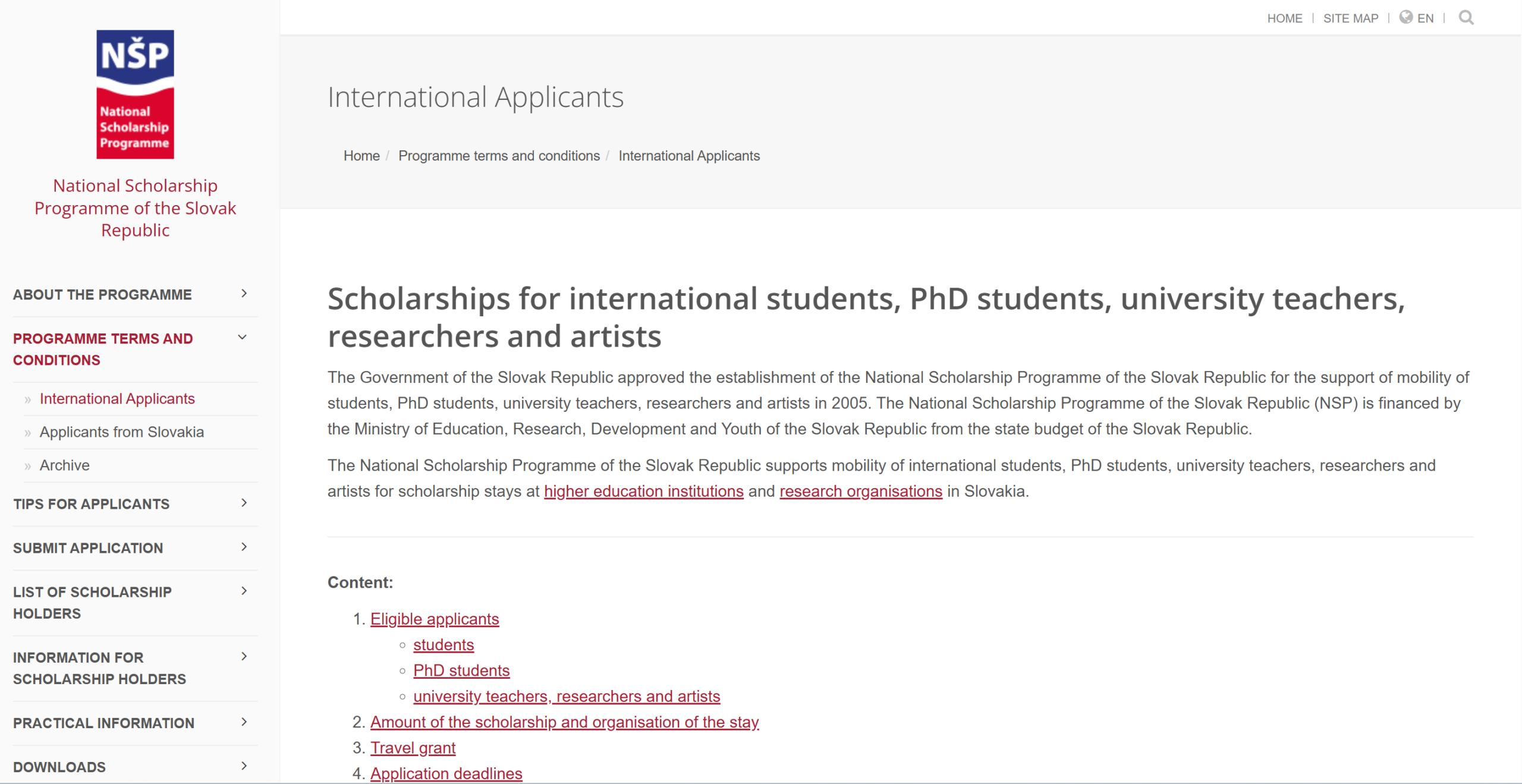
National Scholarship Programme and other funding
The National Scholarship Programme mainly supports study, research, teaching and artistic mobility. It should not be presented as a general full-degree scholarship for every new international student. Eligibility, monthly support, travel allowance and deadlines depend on applicant type and the current call.
The official Study in Slovakia portal also provides a scholarship database and information about bilateral programmes. Universities may publish their own merit, social or programme-specific support, but selection and payment rules differ. Never budget on the assumption that admission automatically produces a scholarship or that funding covers all tuition and living costs.
How foreign-education recognition works
Recognition is not one universal “nostrification” procedure. The correct route depends on the qualification and why you need it. For continuing study, a foreign secondary-school qualification and a foreign higher-education qualification may be handled by different authorities.
- Bachelor’s applicants: recognition of a foreign secondary-school leaving certificate is generally handled by the relevant Regional School Administration Office.
- Master’s or further-study applicants: the Ministry, a Slovak higher-education institution or an available recognition statement may be relevant, depending on the required type of recognition.
- Regulated professions: professional recognition is a separate process and should not be confused with academic recognition for admission.
Start with the Ministry of Education’s Recognition Portal navigator. It identifies the appropriate route and current document requirements. Our practical guide to foreign qualification recognition in Slovakia explains the terminology and preparation steps in more detail.
Begin early, but do not order expensive translations or authentication until you know the route and the university’s requirements. Some applicants can use a recognition statement; some documents are covered by international agreements; and Czech education documents have special treatment for most non-regulated purposes.
Submit the application without losing track of details
- Save the current admissions notice as a PDF or screenshot and note its academic year.
- Use the application system linked by the university or faculty. PortalVS also provides a central electronic application service, but follow the institution’s stated route.
- Enter names and qualification details exactly as shown on official documents.
- Upload every mandatory attachment before submitting; a saved draft is not a submitted application.
- Pay the stated fee using the correct amount, account and payment reference.
- Keep the submission confirmation, payment proof and all correspondence.
- Check the portal and email for requests, examination details and the admission decision.
If you apply to several programmes, treat each as a separate case. A different programme may require another application, fee or recognition document. Ask the admissions office rather than copying instructions from another faculty or a previous academic year.
What to do after admission
Read the admission decision and enrolment instructions immediately. Check whether the offer is conditional, when original documents must be presented, whether tuition or a deposit is due, and what happens if a residence application is delayed.
Non-EU/EEA/Swiss students should separately verify the immigration route and timing. An admission letter supports the process but does not itself grant residence. Use current official instructions and our overview of Slovak residence for non-EU citizens. Also confirm accommodation and health-insurance obligations before arrival; the university’s international office can explain its enrolment-specific requirements.
Arrange housing early if your university does not guarantee a dormitory place. Before paying a private-landlord deposit, review the lease and warning signs in our guide to renting an apartment in Slovakia.
Final application checklist
- I selected a specific programme and read its current admissions notice.
- I confirmed the deadline, application route, fee and payment reference.
- I checked language, exam, interview or portfolio requirements.
- I identified the correct recognition route before ordering translations.
- I submitted all attachments and saved confirmation.
- I checked scholarships separately and did not confuse mobility funding with full-degree funding.
- I have a plan for enrolment, residence, insurance and accommodation after admission.
The safest approach is simple: use PortalVS to research options, use the faculty’s current notice to apply, use the Ministry portal for recognition, and use each scholarship programme’s live page for funding. That prevents outdated dates or general advice from overriding the rules that apply to your actual course.